


Search visibility measures how often and how prominently your website appears in search engine results for relevant queries. Rather than focusing on a single keyword ranking, it evaluates your overall presence across search by combining keyword positions, impression share, click-through rates (CTR), and search demand. The higher your visibility, the more opportunities your site has to earn organic impressions, clicks, and conversions.
Improving search visibility means strengthening every factor that influences how search engines surface your pages. This includes technical SEO, content relevance, authority signals, and user engagement.
What Is Search Visibility in SEO?
Search visibility is the estimated share of clicks, or potential clicks, your site earns from search results across a defined set of keywords. For example, if a keyword is searched 100 times and your page receives 10 clicks, your visibility for that query is 10 percent. SEO tools apply this logic across many keywords to produce a single, aggregated visibility metric.
Modern SEO platforms calculate visibility using a combination of ranking positions, search volume, and expected CTR. In simple terms, high visibility means your pages frequently appear near the top of the results for valuable queries. Low visibility means your site is rarely seen when users are actively searching.
How Can You Determine Search Visibility?
Using SEO tools
Most professional rank-tracking tools convert your keyword rankings into a visibility percentage that estimates how much of the potential click share you capture across a tracked keyword set.
Moz’s Search Visibility score represents the percentage of clicks it estimates you receive based on ranking positions and modeled CTRs across all tracked keywords.
Platforms like Semrush, Ahrefs, and SE Ranking use similar inputs—position, search volume, and expected CTR curves—to express your estimated share of available impressions or clicks, typically from 0% (no presence) to 100% (dominant visibility).
Platforms like Semrush, Ahrefs, and SE Ranking use similar inputs—position, search volume, and expected CTR curves—to express your estimated share of available impressions or clicks, typically from 0% (no presence) to 100% (dominant visibility).
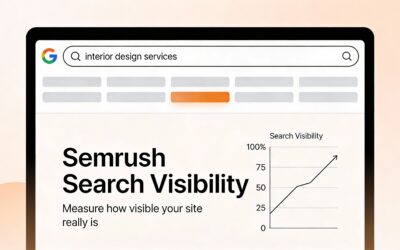
In Semrush, this calculation is presented as Semrush search visibility, a percentage designed to show how much of the available SERP opportunity your site is capturing across tracked keywords.
Using Google Search Console
Google Search Console does not provide a single visibility score, but its Performance report is an excellent free proxy for search visibility.
You can gauge how visible your site is by monitoring total impressions, average position, and CTR for queries and pages over time.
Rising impressions with stable or improving average positions often signal expanding visibility across long‑tail queries before significant traffic growth shows up in click numbers.
The Difference Between Organic and Paid Visibility
Organic search visibility is earned through SEO. It reflects how often your pages appear in unpaid results, including features such as featured snippets, People Also Ask, image packs, and AI Overviews. It builds over time through strong content, technical health, and authority.
Paid visibility, by contrast, is purchased through search ads and Shopping placements. It depends on bids, budgets, and ad quality. While paid results can dominate a SERP quickly, they disappear once spend stops. Combining organic and paid visibility often delivers the greatest overall presence on the results page.
What Is a Good Search Visibility Score?
A “good” visibility score depends heavily on context. Industry competition, keyword difficulty, and the size of your tracked keyword set all influence what is realistic. In highly competitive spaces, even low double-digit visibility can signal strong performance.
Rather than aiming for a specific percentage, it is more useful to benchmark against competitors and your own historical data. A healthy visibility profile trends upward over time and shows you steadily capturing a larger share of relevant search demand.
How Is Search Visibility Calculated?
Although formulas vary between tools, most follow the same core approach. Rankings, search volume, and CTR assumptions are combined to estimate your share of potential clicks.
For a single keyword, visibility can be expressed as:
Visibility = (Clicks ÷ Search Volume) × 100
When scaled across many keywords, tools often replace actual clicks with estimated clicks based on position-based CTR curves. These are then normalised against the maximum possible clicks if your site ranked at the top for all tracked terms.
Because platforms use different CTR models, keyword sets, and weighting systems, visibility scores are directionally comparable but not identical across tools.
What Causes Search Visibility to Drop?
Visibility declines usually have clear, identifiable causes:
- Ranking changes due to competitor improvements or algorithm updates
- Technical issues such as noindex tags, crawl errors, or broken redirects
- Content decay when pages become outdated or misaligned with search intent
- Backlink erosion from lost or weakened authority signals
- SERP feature expansion, including ads and AI Overviews, which can reduce organic CTR even when rankings remain stable
Diagnosing a drop requires reviewing keyword distribution, page-level impressions, and device-specific performance in Search Console and rank tracking tools.
How to Boost Your Search Engine Visibility
Improving visibility requires a structured, repeatable SEO program:
- Keyword strategy: Target intent-driven keywords with realistic competition. Prioritise topic clusters over isolated terms.
- High-quality content: Create original, comprehensive content that satisfies search intent better than competing pages.
- On-page optimisation: Refine titles, meta descriptions, headings, internal links, and structured data to improve SERP appearance.
- Technical SEO: Maintain fast load times, mobile-first design, strong crawlability, and secure HTTPS connections.
- Backlink building: Earn relevant, authoritative links through outreach, partnerships, and content promotion.
- User experience: Improve navigation, readability, and engagement signals to reinforce content value.
- Local SEO: Optimise Google Business Profile, citations, and location pages to improve local search visibility.
- Monitor and iterate: Track impressions, rankings, and CTR, and test improvements to titles, snippets, and content.
- Combine organic and paid efforts: Use paid search to cover high-intent gaps while organic visibility compounds over time.
Frequently Asked Questions
How long does it take to improve search visibility?
Small improvements can appear within weeks, but meaningful gains often take months, depending on competition, site history, and resources.
Can I measure visibility separately for mobile and desktop?
Yes. Most SEO tools and analytics platforms allow device-specific visibility and ranking analysis.
Should I focus on visibility or organic traffic?
Both matter. Visibility reflects potential reach, while traffic and conversions show realised value. Visibility often acts as an early indicator.
Do SERP features affect search visibility?
Yes. Featured snippets and other rich results can increase visibility even if traditional rankings change.
Is paid search visibility useful for SEO?
Paid search does not directly affect rankings, but it can increase brand awareness and provide keyword insights that inform SEO strategy.
Is Search Visibility the Same as Ranking?
No. Ranking refers to your position for a single keyword. Search visibility estimates how many clicks you are likely to earn across many keywords, based on rankings and search demand.
Why Does Search Visibility Fluctuate Day to Day?
Minor ranking changes, shifts in search volume, SERP experiments, or updates to your tracked keyword set can all move visibility scores even when traffic remains steady.
Can I Compare Visibility Scores Across Tools?
Not accurately. Each platform uses different keyword sets and CTR models. Track trends within one tool and compare competitors using the same data source.
Does Branded Search Inflate Visibility?
Yes. Branded keywords typically rank more easily and attract higher CTR, so many teams track branded and non-branded visibility separately.
How Often Should I Measure Search Visibility?
Weekly checks are useful during active optimisation periods, while monthly reviews are better for assessing long-term progress and competitive movement.

0 Comments